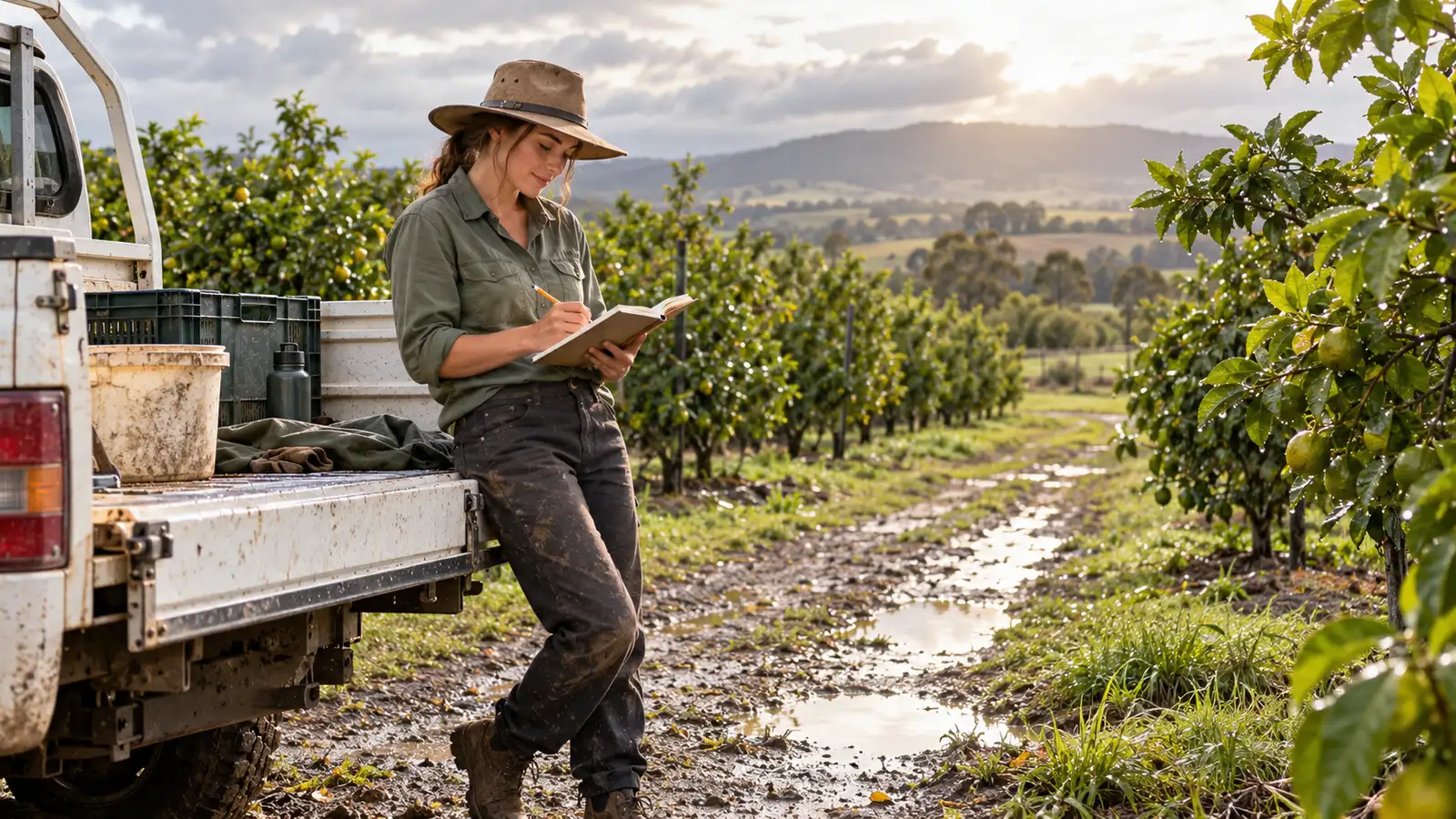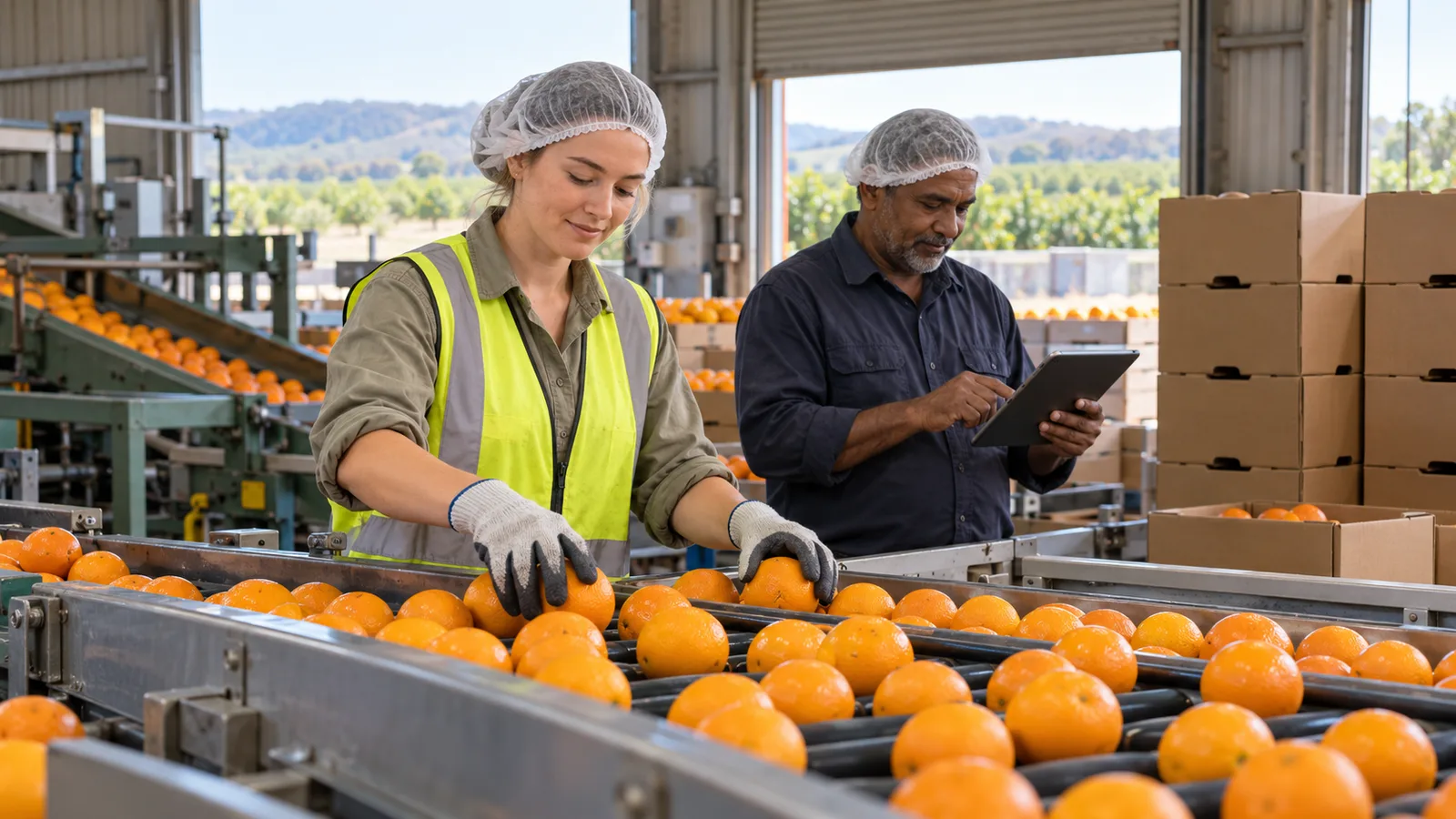
What counts as specified work comes down to two questions, and the job title answers neither: what you actually do all day, and the postcode where you do it. Harvesting and packing fruit and vegetables on a farm in a regional postcode usually fits. A cafe shift, a winery job or gardening work can look like farm work and still miss, depending on the tasks, the industry and the location. This guide sorts the jobs that usually qualify from the grey areas, so you can check a job before you start counting days.
The two tests: your duties and the postcode
Home Affairs defines specified work as work in a "specified" industry and area of Australia. It is what second and third Working Holiday Maker visas require in certain circumstances, so both halves matter. The right job in the wrong postcode does not count, and the wrong job in the right postcode does not count either.
"Farm hand" can mean picking and packing (plant and animal cultivation) or mowing the homestead lawn (general garden maintenance, which Home Affairs says is not eligible). "Kitchen hand" can count in Darwin but not in many regional towns further south, because tourism and hospitality only count in certain parts of Australia. Read the duties, then the postcode.
Your visa matters too. The 417 and 462 lists overlap but are not the same. Check the specified work page for the 417 visa or the specified work page for the 462 visa, whichever matches the visa you hold, and keep it open while you read the rest of this guide.
Specified work industries on the 417 and 462 lists
This table puts the two lists side by side. It is a planning guide only: Home Affairs decides each application.
| Industry | Working Holiday (417) | Work and Holiday (462) |
|---|---|---|
| Plant and animal cultivation | Regional Australia | Northern Australia and the listed regional postcodes |
| Construction | Regional Australia | Northern Australia and the listed regional postcodes |
| Fishing and pearling | Regional Australia | Northern Australia only |
| Tree farming and felling | Regional Australia | Northern Australia only |
| Mining | Regional Australia | Not on the list |
| Tourism and hospitality | Northern or Remote and Very Remote Australia | Northern or Remote and Very Remote Australia |
| Bushfire and natural disaster recovery | Declared areas | Declared areas |
For 462 holders, work in the listed regional postcodes outside the north counts only in plant and animal cultivation and construction.
On postcodes, the simple part first: every postcode in South Australia, Tasmania, the Northern Territory and Norfolk Island is regional Australia for specified work. Other states list ranges. Western Australia, for example, counts 6200 to 6799 plus a handful of postcodes closer to Perth, and the 462 list uses the same regional postcodes as the 417 list. Every Northern Territory postcode is also in Northern Australia and in Remote and Very Remote Australia.
What usually counts on a farm
Most seasonal work falls under plant and animal cultivation. Home Affairs describes it as harvesting and/or packing fruit and vegetable crops, and the immediate processing of animal products such as shearing, butchery, packing and tanning. Pruning and trimming vines and trees for commercial horticulture can be included when that is the main task.
Home Affairs' own examples include:
- picking fruit on an orchard
- immediate processing of plant products
- manufacturing dairy produce from raw material
- feeding and herding cattle
- conservation and environmental reforestation work
For a wider look at sheds, stations and vineyards as jobs, not just as eligible work, read our guide to seasonal jobs beyond fruit picking.
The grey areas that catch people out
For each of these, ask the same question: does the main task fit an eligible industry, in an eligible postcode, for your visa?
Packing sheds and processing plants
Packing fresh fruit and vegetables is part of the definition, so packing-shed work on harvested produce usually fits. Home Affairs says secondary processing does not count, and lists winemaking, brewing and distillation, milling, manufacturing small goods, and retail of dairy or butchery products. So "does packing count for 88 days?" usually has a yes answer for packing fresh crops, and a no answer once the produce is being turned into another product.
The farm shop, cafe or cellar door
Selling the farm's produce is retail, not harvesting, and retail of dairy or butchery products is on the excluded list. A cafe or cellar door on a vineyard is hospitality. Tourism and hospitality count only in Northern Australia, Remote and Very Remote Australia, or postcodes 4406, 4416, 4498 and 7215, for work done from 22 June 2021 and second or third visa applications lodged from 5 March 2022. The same cafe job can count in one place and not in another.
Office, admin and cleaning roles
This is the area with a softer approach for now, so check the page again before you rely on it. Home Affairs says it is temporarily giving greater weight to the specified industry, so work that supports the ongoing operations of a specified industry, such as administrative and cleaning support services, in an eligible postcode may be accepted. "May be accepted" is not "counts", so keep a note of how your work supported the farm, mine or site.
Gardening and landscaping
General garden maintenance is not eligible. Landscaping the grounds of a construction site is one of Home Affairs' construction examples, and so are painting new buildings, erecting fences on a construction site, scaffolding, and construction support and cleaning. The difference is the industry: a garden is not a construction site.
Volunteering and work for a bed
Paid or volunteer bushfire recovery work in declared bushfire-affected areas counts if it was done after 31 July 2019. Paid or voluntary recovery work after 31 December 2021 in areas declared affected by flood, cyclone or other severe weather counts for applications lodged on or after 5 April 2025. Outside declared recovery work, Home Affairs says all specified work must be paid in accordance with Australian legislation and awards, so "help on the farm in exchange for a bed" does not fit the rules.
Check any job in five steps
- Ask for the farm or worksite address, including the postcode, and the business name and ABN. Fair Work advises checking the business at the Australian Business Register before you accept.
- Write down the main task in plain words: picking, packing fresh produce, pruning, feeding stock, building work, kitchen work.
- Match the task to an industry on the list for your visa, using the table above and the Home Affairs page.
- Check the postcode against the regional, Northern or Remote and Very Remote lists for that industry.
- Confirm the job is paid under the right award, then keep your records from the first day.
If any step leaves you unsure, treat the job as not counting until you have checked. When you are ready to apply, the seasonal jobs board lets you search by state and type of work.
How days, pay and records decide what you can claim
The right job is only half of it. For a second visa, Home Affairs takes 3 months as at least 88 calendar days, including weekends or equivalent rest days. For a third visa it is 6 months, or at least 179 calendar days, of specified work done on or after 1 July 2019. You need the days or shifts a full-time worker in that role would normally work in that time.
A few rules trip people up:
- One calendar day counts as one day at most, however long the shift or however many employers you work for that day.
- Paid public holidays and paid sick days count; unpaid days lost to weather do not, and there is no exception for falling short.
- Rosters that are standard in the industry can count: Home Affairs gives the example of a paid full-time roster of 2 weeks on and 2 weeks off counting all 4 weeks (28 days).
Every day must be paid lawfully, which is why payslips are your best evidence. A payslip must show the employer's ABN (if any), the pay period, the hours and rate, and super. Fair Work's Record My Hours app lets you keep your own record of hours, where you worked and the type of work. Our guide to the records to keep from day one shows what to save each week, and our payday check for farm and harvest work helps you spot a payslip that would not hold up.
Optional: a verified Talent Tabloid profile lets employers check your experience and can help your application stand out when you look for the next job.
Six months with one employer
Visa condition 8547 normally limits Working Holiday Makers to 6 months' work with any one employer. From 1 January 2024, work in plant and animal cultivation anywhere in Australia is one of the exemptions, along with natural disaster recovery and the critical sectors. The 6-month work limitation page has the full list.
Planning the whole second or third year rather than one job? Our second year visa timeline walks through it from week one, and the 88 days guide sums up the counting rules.
Rules, pay rates and visa conditions can change. Check the official government website before you act.
Common mistakes about what counts
- Trusting the job title. "Farm hand" or "kitchen hand" says nothing on its own. The main task and the industry decide it.
- Skipping the postcode check. A farm near a capital city may sit outside the regional list. Check the exact postcode.
- Using the other visa's list. A 462 holder working in a mine, or fishing outside Northern Australia, may be counting days that do not fit the 462 rules.
- Counting secondary processing. Winery, brewery, mill and small goods work is excluded, even on a farm property.
- Taking the employer's word for it. An employer cannot decide your specified work; Home Affairs does.
- Working for a bed. Unpaid farm help outside declared recovery work does not count.
Frequently asked questions
Does packing count for 88 days?
Packing fresh fruit and vegetable crops is part of Home Affairs' definition of plant and animal cultivation, so it usually counts in an eligible postcode. Secondary processing, such as winemaking, milling or making small goods, does not count.
Does hospitality work on a farm count as specified work?
Only in Northern Australia, Remote and Very Remote Australia, or postcodes 4406, 4416, 4498 and 7215. Elsewhere, a farm cafe or cellar door does not count, even in a regional postcode.
Can office or cleaning work on a farm count?
Home Affairs says it is temporarily giving greater weight to the industry, so admin and cleaning support for a specified industry in an eligible postcode may be accepted. Keep records showing how your work supported the farm.
Is the specified work list the same for 417 and 462 visas?
No. Both cover plant and animal cultivation, construction, tourism in the north and remote areas, and disaster recovery, but the 462 list leaves out mining and limits fishing, pearling and tree farming to Northern Australia. Use the list for the visa you hold.
Do UK passport holders need specified work?
UK passport holders who lodge a second or third Working Holiday visa on or after 1 July 2024, using a passport issued by the United Kingdom, do not need to meet the specified work requirement. Other 417 and 462 holders still need it in the circumstances set out on the Home Affairs page.
Key takeaways
- Specified work is a matching industry plus an eligible postcode, for your visa.
- Harvesting, packing fresh produce, pruning and stock work usually fit; secondary processing and garden maintenance do not.
- Tourism and hospitality count only in Northern, Remote and Very Remote Australia and four listed postcodes.
- Admin and cleaning support may be accepted under a temporary approach: not certain.
- Only paid work counts, apart from declared bushfire and disaster recovery volunteering.