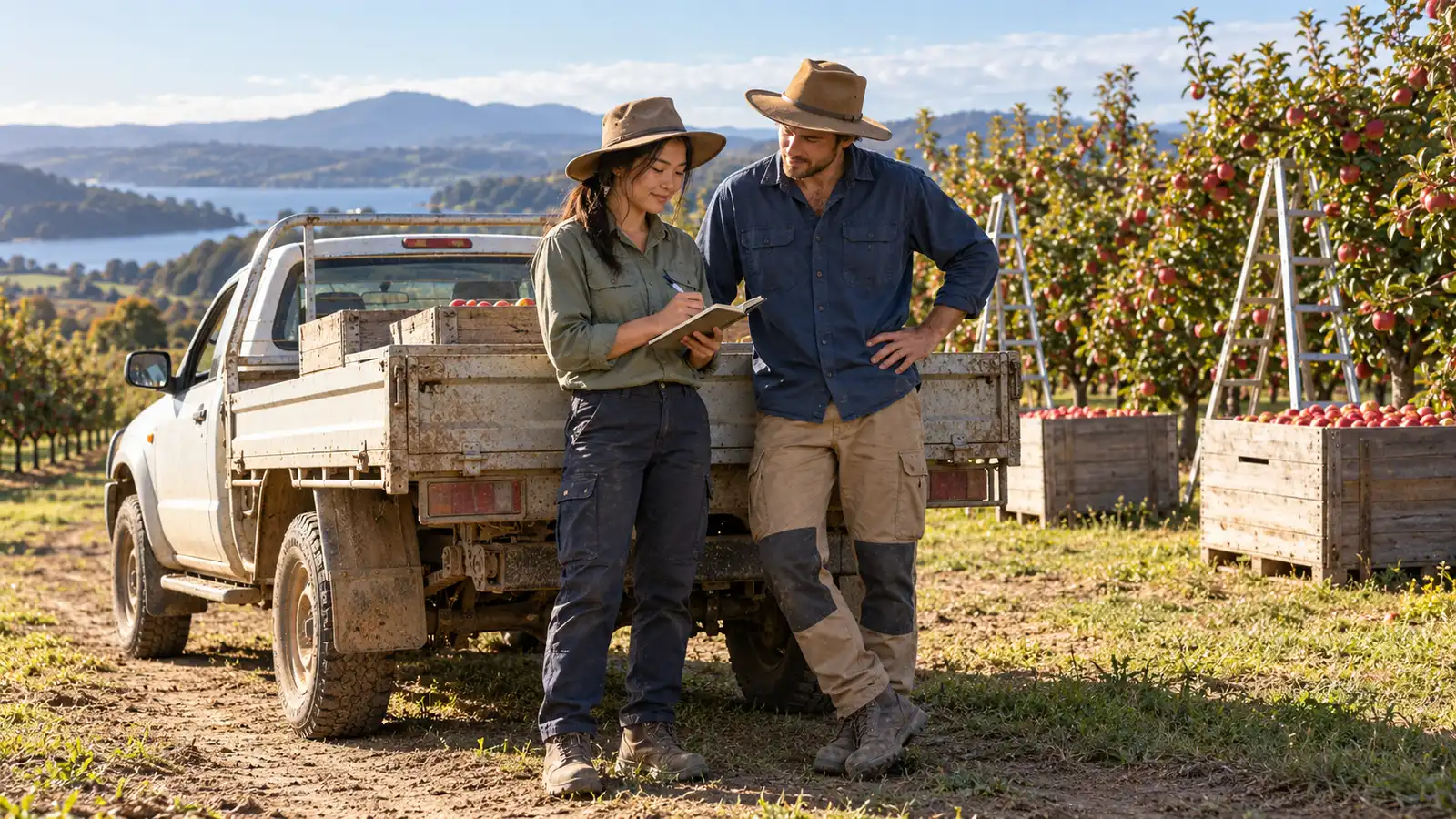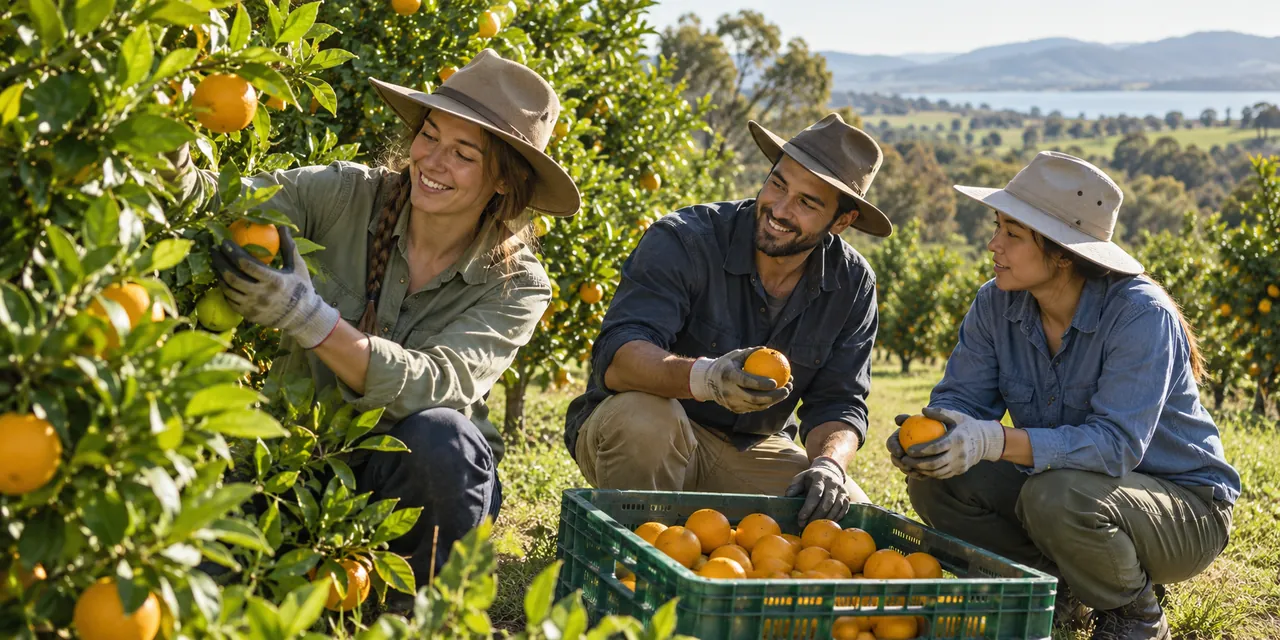
Fruit picking jobs in Australia come in four kinds of work: ground crops such as strawberries and vegetables, bush crops such as blueberries and raspberries, tree fruit such as apples, cherries, citrus and mangoes, and vines such as wine grapes. Each asks something different of your back, your hands and your patience, and each can be paid by the hour, by the piece or a mix of both. For a first season, a crop and a role where you understand exactly how you are paid matters more than the crop itself.
What a fruit picker actually does all day
The fruit picker job description sounds simple. You pick ripe produce to the grower's standard, put it in a bucket, tray, bag or bin without bruising it, and work your way along the row. Many jobs add grading and carrying full containers to a collection point.
The hard part is doing it all day, outdoors and often in the sun. Safe Work Australia describes hazardous manual tasks as lifting, carrying and holding with repetitive movement or awkward postures, and warns they can cause sprains, strains and back injuries.
There is a second reason working holiday makers care about the job description. Home Affairs counts harvesting and packing fruit and vegetable crops as plant and animal cultivation, which can be specified work for a second or third visa when it is done in an eligible regional postcode and meets the other rules. Secondary processing, such as winemaking, does not count.
If picking is part of your plan for another year in Australia, our second year visa planning guide sets out a week-by-week timeline from your first job to lodging.
Four kinds of picking work, side by side
How the fruit grows decides what your body does all day. Use this table to narrow your search before you look at dates and places.
| Crop group | Examples | What your body does | Worth knowing |
|---|---|---|---|
| Ground crops | Strawberries, broccoli, carrots, potatoes | Bending or kneeling low, moving along the row on your feet or knees | Hardest on the back and knees; ask what equipment the farm provides |
| Bush crops | Blueberries, raspberries | Standing and hand picking small, soft fruit at waist to chest height | Careful hands matter more than speed while you learn |
| Tree fruit | Apples, pears, cherries, citrus, mangoes | Climbing ladders, reaching overhead, carrying a full picking bag | Ladder confidence helps; mango sap can irritate the skin |
| Vines | Wine grapes, table grapes | Bending to bunch height, cutting with snips, filling buckets or bins | Wine grape work usually falls under the Wine Award, with its own pay rules |
Ground crops: low, steady and hard on the back
Strawberries and field vegetables grow close to the ground, so you spend the day bent over or kneeling. The produce is light, but the posture is not. Tasmania lists strawberries from October to May, so ground crops can offer long seasons in one place.
Bush crops: careful hands over fast hands
Blueberries and raspberries are picked standing up, which most people find easier on the body. The fruit is small and bruises easily, so growers watch quality closely. Tasmania's official harvest dates show blueberries and raspberries from December to May. For a beginner they are a gentle way to learn the rhythm of a picking day.
Tree fruit: ladders, bags and reaching
Apples, pears, cherries, citrus and mangoes mean ladders and a picking bag worn on the front of your body that grows heavy as it fills. Follow the farm's ladder and safety instructions every time. In the Northern Territory, mangoes grow around Darwin and Katherine and are usually harvested between September and December. The NT Government warns that mango sap is caustic and can irritate the skin, so long sleeves and gloves are worth having. Cherries are short and busy: our cherry harvest plan by region helps you time a summer search.
Vines: snips, buckets and the Wine Award
Wine grape picking means bending to bunch height and cutting bunches with snips or secateurs all day. Tasmania lists wine grape picking from February to May and pruning from June to August, so vineyards can give work in two seasons.
How fruit pickers are paid
Fair Work says horticulture employees are usually covered by the Horticulture Award or the Wine Award, labour hire workers can be covered by these awards too, and you can be paid hourly rates, piece rates or both. Our pay and conditions guide covers the full detail.
Hourly rates
From 1 July 2026, the Horticulture Award minimum hourly rate for an adult level 1 employee picking, sorting or packing fruit and vegetables is $25.74 for full-time and part-time employees and $32.18 for casuals. You can only be employed at level 1 for a maximum of 3 months, and earlier time in the horticulture industry counts towards that.
For wine grapes, the Wine Award minimum for an adult grade 1 employee picking grapes or pruning vines is $25.79 full-time and $32.24 casual from 1 July 2026. You must be paid for all the work you do, including training and meetings.
Piece rates
A piece rate pays by output, such as kilograms or bins picked, and under the Horticulture Award it is based on your own effort only, not a group's. Before piecework starts, your employer must give you a written piecework record, signed by the employer, with the start date and time, the task, the piece rate, your hourly rate and the award's minimum wage guarantee statement. Fair Work explains it on its pay and piece rates page.
The piece rate must let a pieceworker working at the average productivity of a competent pieceworker earn at least 15% more than the hourly rate: at least $29.60 an hour for a level 1 full-time or part-time employee and $37.01 for a level 1 casual. The award treats a pieceworker as competent once they have at least 76 hours' experience at that task, such as picking apples or strawberries.
Under the Horticulture Award there is also a minimum hourly guarantee. In Fair Work's example, a level 1 casual pieceworker working 7.6 hours must get at least $244.57 for the day. If you do any other work besides the piece-rate task, that work is paid at your hourly rate. The Wine Award works differently: its piece rate must let an employee of average capacity earn at least 20% more per hour than the minimum rate, but it has no minimum wage guarantee for pieceworkers. Our post on checking piecework pay before you pick goes further.
Which crop suits a first-timer?
Think about what your body copes with and how you will be paid while you are still slow.
- New to physical work: bush crops or packing roles, where you stand and the loads are light, are an easier start than ground crops.
- Fit and happy at height: tree fruit suits you if ladders do not bother you and you can carry a full bag safely.
- Bad back or knees: think twice about strawberries and low vegetable crops, however long the season.
Our guide to farm work with no experience and the post on questions to ask before your first farm job go further for beginners.
How to choose and land your first picking job
- Check what you need the work for. If you are counting 88 days for a second visa, check the postcode and the type of work against Home Affairs' rules before you accept, and start keeping records from the first day, as our 88 days records guide explains.
- Match the crop to the month. Open the seasonal work calendar for typical windows by state, and read our post on chaining fruit picking seasons if you want more than one crop.
- Ask before you travel. Ask for the business name and ABN and check it on the Australian Business Register, ask which award applies, whether pay is hourly or by the piece, and for the piecework record in writing.
- Get a short application ready. A one-page CV that lists outdoor work, early starts, a driver licence and any farm or warehouse experience helps; Build AI CV can turn your notes into a tidy one for harvest work.
- Search and apply. Browse seasonal job listings by state and type of work.
- Keep your own record. Fair Work's free Record My Hours app lets you log your hours, where you worked and the type of work.
Common mistakes first-time fruit pickers make
- Following an offer for the wrong fruit. Fair Work lists jobs picking the wrong seasonal fruit as a warning sign, along with upfront fees and ads with little business information.
- Paying to get a job. Employers can't ask job applicants to pay money to receive a job offer.
- Starting piecework with nothing in writing. No signed piecework record before you start is a reason to ask questions, not to start picking.
- Accepting group rates or overfilled bins. Employers can't apply group rates, ask you to overload buckets or bins, or ask you to pick bad produce for free.
- Thinking any farm-related job counts. Winery, brewery and other secondary processing work does not count as specified work.
- Coming on the wrong visa. Work rights depend on the visa you hold. If you hold a Malaysian passport, JobsAbroad Malaysia's guide on fruit-picking trips offered on an ETA explains the risk.
Rules, pay rates and visa conditions can change. Check the official government website before you act.
Frequently asked questions
Do I need experience to get fruit picking jobs in Australia?
Each listing says what it asks for, so read it closely. Under the Horticulture Award, an employee can only be employed at level 1 for a maximum of 3 months, and earlier horticulture work counts towards that, so experience can move you up a level. Bush crops and packing roles are a common way for beginners to start.
How much do fruit pickers get paid in Australia?
From 1 July 2026, the Horticulture Award level 1 minimum is $25.74 an hour for full-time and part-time employees and $32.18 for casuals. Piece rates must let a competent pieceworker at average productivity earn at least 15% more than the hourly rate. Fair Work's Pay and Conditions Tool checks your own award and level.
Does fruit picking count towards my 88 days?
Harvesting and packing fruit and vegetable crops is plant and animal cultivation, which can count as specified work. It must be done in an eligible regional postcode, paid lawfully and meet Home Affairs' other rules, including 88 calendar days for a second visa. Check the official specified work page before you rely on a job.
Is piece rate or hourly pay better for a new picker?
Hourly pay is easier to understand while you are still slow. Horticulture Award pieceworkers have a minimum hourly guarantee for the hours worked, but the Wine Award has none for pieceworkers. Either way, get the piecework record in writing first.
Can I find my own accommodation while picking fruit?
Yes. Fair Work says you have the right to choose where you live, such as a share house, caravan park or backpacker hostel, even when an employer offers accommodation. Be wary of paying upfront for accommodation before you have found a job.
Key takeaways
- Picking work falls into ground crops, bush crops, tree fruit and vines, and each is hard on the body in a different way.
- Horticulture Award pickers can be paid hourly, by the piece or both, and piecework needs a signed written record first.
- Wine grape work usually falls under the Wine Award, which has no minimum wage guarantee for pieceworkers.
- Bush crops and packing roles are often the easiest start for someone new to farm work.
- Never pay for a job, and check the business and its ABN before you travel.