Fruit picking seasons in Australia follow the crops, not the calendar year: each crop and region has its own typical window for pickers, packers and pruners. Knowing those windows lets you line up your next job before the current one ends. Use it to plan, not to book: every window is typical and regional, never a fixed start date. Chain two or three crops in the right order and one good plan can carry you through most of the year.
How to read a harvest calendar, and what it cannot tell you
The Seasonal Jobs Australia harvest calendar shows typical harvest, vineyard, ski and tourism windows by month and by state. It shows typical seasons. It is not a count of live vacancies, and it is not a forecast of this year's crop.
Once you know which crop you are aiming for, our step-by-step guide on how to find farm work in Australia shows how to apply, what to ask on the call and how to check an offer.
That difference matters on the ground. A cold spring can push a crop back, and hail, rain or heat can end one early or stop picking for days at a time. Read every window as "this is when the work usually happens here", then confirm the real start date with the employer before you put fuel in the car.
Three questions turn a calendar into a plan:
- When is the work usually busiest in this region?
- What starts nearby, or a reasonable drive away, as this crop winds down?
- If you need specified work for another visa, does this type of work in this postcode count?
Typical harvest windows confirmed by state governments
Some state agriculture departments publish their own harvest timing. The windows below come from those official pages, and they make a solid backbone for a year plan.
| Region | Work | Typical months |
|---|---|---|
| Northern Territory (Darwin and Katherine) | Mango harvest | Usually September to December |
| Tasmania | Strawberries | October to May |
| Tasmania | Cherries | December to February |
| Tasmania | Blueberries and raspberries | December to May |
| Tasmania (north and south) | Apples; pears | Apples February to May; pears February to March |
| Tasmania (all three regions) | Wine grape picking; wine grape pruning | Picking February to May; pruning June to August |
| Tasmania (north and north-west) | Carrots; processing potatoes; broccoli | Carrots January to August; potatoes February to August; broccoli November to June |
| Tasmania (north-west and south) | Hops picking; hop stringing and training; shearing shed hands | Picking February to March; stringing June to November; sheds April to August |
| South Australia | Citrus, including Riverland navel oranges | Peak in the colder months |
| Western Australia (Carnarvon, Gascoyne) | Vegetables such as tomatoes and capsicums | Main growing season in autumn, winter and spring |
Tasmania stands out. Its Department of Natural Resources and Environment says the state has harvest jobs available for nearly 12 months of the year, and it publishes harvest dates by crop and region. In Western Australia, the Carnarvon Horticulture District covers over 1,500 hectares of bananas, table grapes, tomatoes, capsicums, melons, mangoes and more, and grows counter-season produce for Perth and interstate markets.
For Queensland, New South Wales and Victoria, use the typical windows on our calendar together with the state guides, such as the Queensland seasonal work guide, and check dates with each employer. Those windows are typical seasons, not promises.
Chaining crops: one example loop through the year
The trick is to finish one crop just as the next one is starting, close enough to travel between them without weeks of unpaid waiting. The official windows above already fit together into one possible loop. Treat it as an example of how the pieces connect, not as a promise of work at any stop.
Not sure which crop to start with? Our guide to fruit picking jobs in Australia by crop type compares ground crops, bushes, trees and vines and what each one asks of your body.
Spring in the Top End: mangoes
The Northern Territory mango harvest usually runs from September to December around Darwin and Katherine, so October sits right in the middle of it. Our October harvest plan covers what else is starting this month. One safety point before you go: the NT Government warns that mango sap is caustic and can irritate the skin, which is different from a mango allergy. Long sleeves and gloves matter in the sheds and the rows.
Summer in Tasmania: cherries and berries
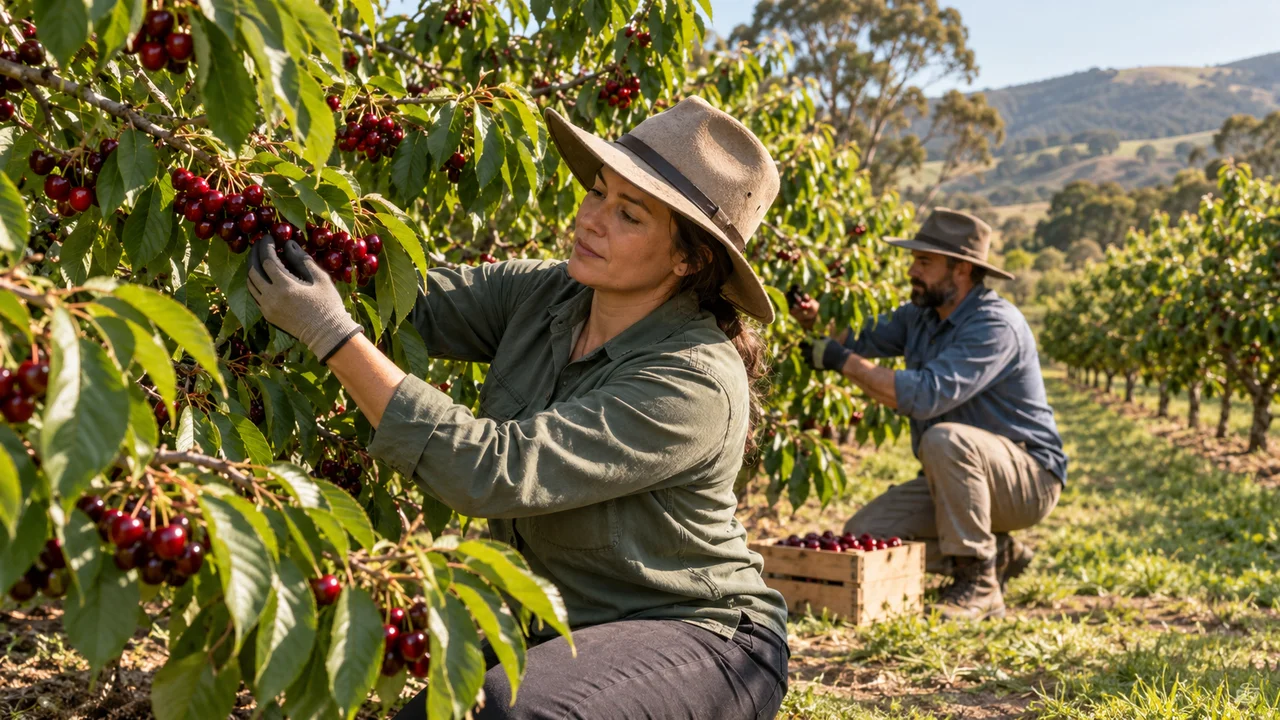
As the mangoes finish, Tasmania's summer fruit takes over. Cherries run from December to February, blueberries and raspberries from December to May, and strawberries are already going from October. Cherry work is short and busy, so read our guide to planning a cherry harvest search by region before you book the ferry or a flight.
Autumn: apples, pears, hops and vintage
From February the orchards and vineyards get busy. Apples run February to May, pears February to March, hops picking February to March and wine grape picking February to May. If you are counting specified work, note that picking grapes is harvesting, but winemaking in the winery is secondary processing and does not count.
Winter: pruning, paddock crops and sheds
Winter is quieter, but not empty. Wine grape pruning runs June to August, processing potatoes until August, carrots until August, and shearing shed hand work April to August. Hop stringing and training starts in June and carries through to November, by which time the loop is back at strawberries and the next mango season. If you would rather go west or south for the cold months, the Carnarvon vegetable season and South Australia's citrus peak both sit in the cooler part of the year.
Making the calendar count for your 88 days
If you hold a 417 or 462 visa and want a second or third one, your route through the calendar also has to meet the specified work rules. Home Affairs takes 3 months of specified work as a minimum of 88 calendar days for a second visa, and 6 months as 179 calendar days for a third. The full conditions are on the Home Affairs specified work page.
Working out when to fit those days into your year? Our second year visa timeline shows when to start specified work, what proof to keep and when to lodge.
A few rules shape a chained season:
- You can split specified work across several employers and crops, but it cannot be completed in a total period shorter than 3 or 6 calendar months.
- Work on one calendar day never counts as more than one day, even if you work a double shift in peak harvest.
- Unpaid days lost to severe or seasonal weather do not count, and Home Affairs makes no exception for weather.
- All postcodes in South Australia, Tasmania and the Northern Territory are regional Australia for specified work. In Western Australia, postcodes 6200 to 6799 are on the list, along with a few others.
- The whole Northern Territory is also Northern Australia, which matters for 462 holders: some industries, such as fishing and pearling, count for them only in northern Australia.
UK passport holders who lodge on or after 1 July 2024 using a passport issued by the United Kingdom of Great Britain and Northern Ireland do not need specified work for a second or third 417 visa. Everyone else should keep records from the first shift: our post on the records to keep from day one walks through payslips, rosters and notes.
Build your season plan in seven steps
- Choose your starting month and region on the calendar, based on where you are now and when you can start.
- Write down the next two crops whose typical windows begin as your first one ends, and the drive or trip between them.
- If you need specified work, check the postcode and the type of work against the official lists before you commit.
- Contact employers before you travel. Ask for the business name and ABN, the expected start date, whether you will be paid hourly or by piece rate, and what accommodation costs.
- Get a short, farm-ready CV that lists your dates, crops and tasks. Build AI CV can help you put one together, so you are ready to apply as soon as a window opens.
- Keep your own record of every shift. Fair Work's Record My Hours app records your hours, where you worked and the type of work.
- Leave a buffer. Home Affairs advises not leaving specified work until the end of your stay, to allow for bad weather, illness or not finding enough work.
Your pay rules travel with you
The crop changes through the year, but the pay rules do not. Most horticulture workers are covered by the Horticulture Award or the Wine Award. From 1 July 2026, the Horticulture Award minimum for an adult level 1 casual picking, sorting or packing fruit and vegetables is $32.18 an hour. Before any piecework starts, your employer must give you a written piecework record with the piece rate, your hourly rate and the Award's minimum wage guarantee statement. Ask for it at every new farm, not just the first one.
Common mistakes when planning around harvest seasons
- Treating the calendar as a job list. A typical window means the work usually happens then. It does not mean anyone is hiring this week.
- Arriving with nothing confirmed. Turning up on the first day of a window can mean waiting while the fruit ripens, with rent going out and nothing coming in.
- Falling for offers that do not fit the season. Fair Work lists jobs picking the wrong seasonal fruit as a warning sign, along with upfront fees and promises of a quick visa. The calendar is your first check: if the fruit is not usually ready, ask why. Fair Work's harvest work tips list the other signs.
- Paying for accommodation before you have a job. A deposit or bond may be normal, but Fair Work says to be wary of paying upfront for accommodation before you have found work.
- Leaving the 88 days too late. A wet fortnight in the last month of your visa can break the plan. Start early and build in spare time.
- Assuming every farm job counts. Winemaking, general garden maintenance and other secondary processing are not specified work, even on a vineyard.
Rules, pay rates and visa conditions can change. Check the official government website before you act.
Frequently asked questions
When is fruit picking season in Australia?
There is no single season, because each crop and region has its own window. In the official examples, Northern Territory mangoes usually run September to December, Tasmanian cherries December to February and Tasmanian apples February to May. Check the calendar for the region you have in mind.
Which state has harvest work for most of the year?
Tasmania's Department of Natural Resources and Environment says the state has harvest jobs available for nearly 12 months of the year. Berries, orchard fruit, grapes, vegetables, hops and shearing sheds overlap through the seasons there.
Can I do my 88 days across different farms and crops?
Yes. Home Affairs says specified work does not have to be done all in one go or with one employer, so a mango farm followed by a cherry orchard can both count. The total period still cannot be shorter than 3 calendar months, and the work and postcodes must meet the rules.
Do I have to change employers after 6 months on a working holiday?
Usually there is a 6-month limit with one employer, but since 1 January 2024 working holiday makers can stay longer with the same employer in plant and animal cultivation anywhere in Australia without asking. Home Affairs says these exemptions apply until the Government makes further decisions.
Is the harvest calendar a list of available jobs?
No. The calendar shows typical seasons by month and state, not live vacancies or a forecast of this year's crop. Use it to decide where to look, then browse current listings and confirm the start date with the employer.
Key takeaways
- Every harvest window is typical and regional: confirm the real start date before you travel.
- Northern Territory mangoes, Tasmanian summer fruit, autumn orchards and winter pruning can link into one loop.
- Specified work can be split across employers, but never finished in under 3 or 6 calendar months.
- Weather days without pay do not count, so start your 88 days early.
- Check the ABN, the pay type and the piecework record at every new farm.