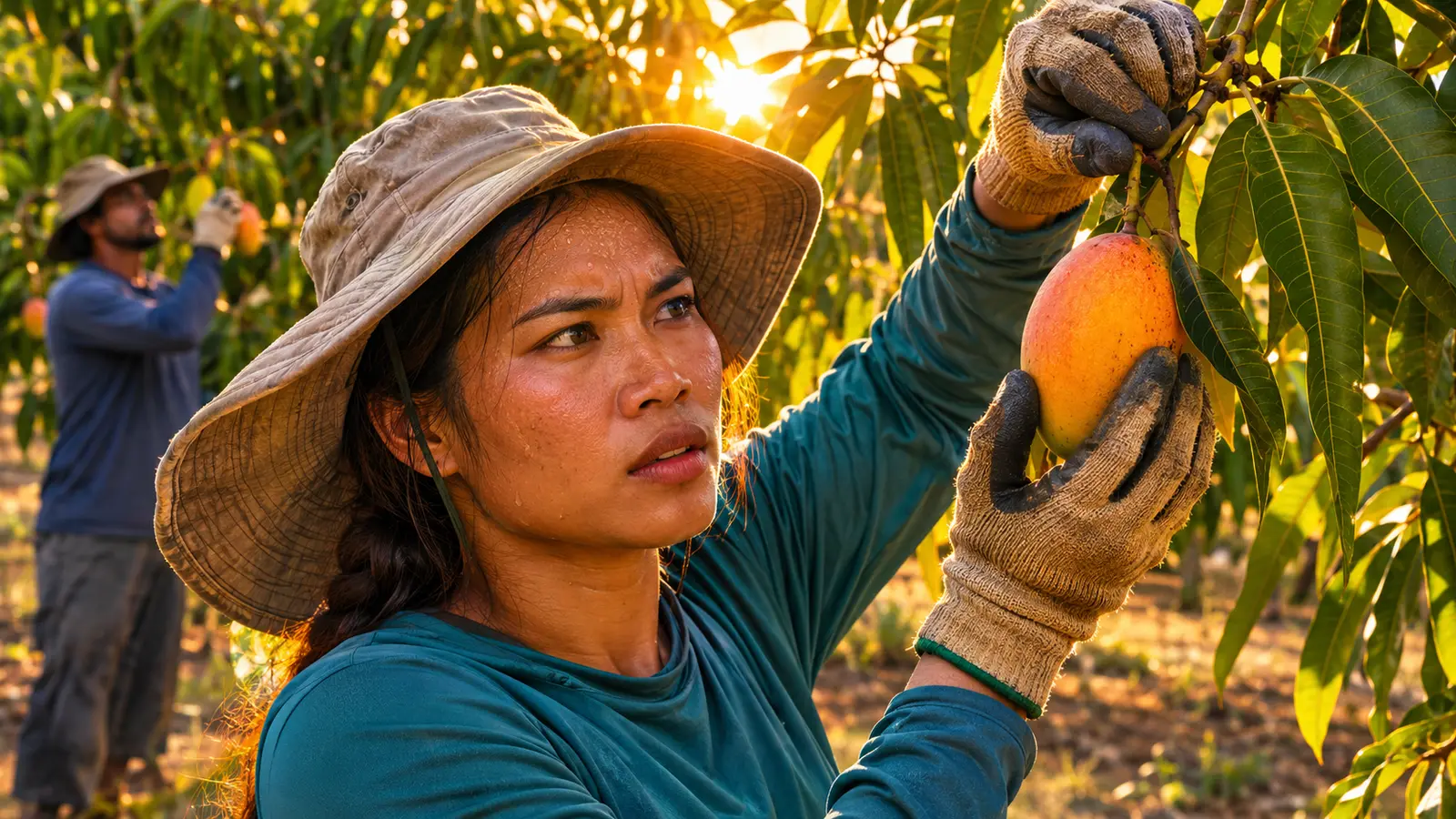
Mango picking jobs in Australia are a short-window job: in the Northern Territory the crop is usually harvested between September and December, which is about four months of work around Darwin and Katherine. If you want to join a crew this season, the questions that matter are where the work is, how you will be paid, how to protect your skin and body, and whether the days count towards a second visa.
Where and when mango work typically happens
The NT Government says mangoes are grown in the Darwin and Katherine regions and are usually harvested between September and December. That puts the northern season in its second half now, so late starters should ask farms how many weeks of picking and packing they still expect.
Western Australia's Gascoyne Development Commission says the Carnarvon Horticulture District covers over 1,500 hectares producing bananas, table grapes, tomatoes, capsicums, melons, mangoes and more. We do not have an official harvest window for its mangoes, so treat any date you hear as a question for the grower. Our seasonal work calendar shows typical windows by month and state, and it is not a count of live vacancies or a forecast of this year's crop.
Our November harvest guide sets mangoes next to Tasmanian crops, which is useful if you plan to chain seasons together. The Northern Territory work guide covers the territory in more detail.
What the work involves: picking, packing and long days
Home Affairs describes plant and animal cultivation as harvesting and/or packing fruit and vegetable crops, and lists picking fruit on an orchard as an example. On a mango farm that means two broad kinds of job: working in the trees and rows, and working on a packing line. Ask which one you are being offered, because the hours, the physical load and the pay arrangement can differ.
Safe Work Australia lists hazardous manual tasks as lifting, carrying, pushing or pulling with repetitive movement, awkward postures or sustained force. Those can cause sprains, strains and back injuries. Ask how bins or crates are moved, whether there are rotations between tasks, and what training you get on day one.
Mango sap burn and protecting your skin
The NT Government warns that mango sap is caustic and can irritate the skin. It also says this is different from a mango allergy, so someone who has eaten mangoes all their life can still get a reaction at work.
The fact sheet we rely on does not give a medical treatment, so we will not either. What you can do is ask practical questions before you start and act early if your skin reacts:
- Ask what protective clothing the farm expects you to wear and whether any is provided.
- Ask who to tell if you get a rash or burn, and where first aid is.
- If a reaction is severe, spreads or does not settle, see a doctor or pharmacist. Do not wait until the end of the shift.
A farm business must prepare an emergency plan and make sure workers can reach first aid equipment and trained first aid officers whenever they are at work, according to Safe Work Australia. You are entitled to ask where those are on day one.
Heat and sun in the north
Safe Work Australia says there is no single maximum temperature at which workers must stop work. Instead, businesses must eliminate or minimise heat risks so far as is reasonably practicable, which may include rescheduling tasks until conditions are cooler. Our heat-ready harvest plan turns that into a practical shift routine.
The people most at risk are workers under 25, older workers, pregnant women, people with physical illness and anyone not acclimatised to heat. If you have just arrived from a cooler climate, count yourself as not acclimatised and build up slowly. Safe Work Australia lists the symptoms of heat-related illness as dizziness, sweating, visual disturbances, fainting, nausea and muscle cramps, and says the illness is progressive and can be life threatening if untreated.
Call an ambulance immediately if heat stroke is suspected. Severe signs include a worker who stops sweating, disorientation, rapid breathing, and vomiting or unwillingness to drink. For dehydration, drink water, avoid caffeinated, carbonated and alcoholic drinks and salt tablets, and replace electrolytes in extreme heat.
How mango pickers are paid
Fair Work says employees in horticulture are usually covered by the Horticulture Award or the Wine Award, and can be paid hourly rates, piece rates or both. From 1 July 2026, the Horticulture Award minimum for an adult level 1 employee picking, sorting or packing fruit is $25.74 an hour for full-time and part-time employees and $32.18 for casuals.
| Pay type | What Fair Work says |
|---|---|
| Hourly rate | Level 1 adult minimum from 1 July 2026: $25.74 (full-time and part-time) or $32.18 (casual) |
| Piece rate | Pays by output such as kilograms or bins and is based on individual effort, not group effort |
| Minimum wage guarantee | A level 1 casual working 7.6 hours must get at least $244.57 for the day, however little they pick |
| Other tasks | Work besides the piece-rate task must be paid at the hourly rate |
The piece rate must let a pieceworker at the average productivity of a competent pieceworker earn at least 15% more than the hourly rate, which is at least $29.60 an hour for a level 1 full-time or part-time employee and $37.01 for a casual. A competent pieceworker is one with at least 76 hours' experience of the task, so a new picker may earn less than that at first. That minimum hourly guarantee is the safety net.
Before piecework starts, the employer must give you a signed written piecework record stating the start date and time, the task, the piece rate, your hourly rate and the minimum hourly guarantee statement. Our posts on piecework pay and checking you are paid correctly go through the paperwork, and the pay and conditions guide covers the Award basics. You can also read the full rules on Fair Work's horticulture pay and piece rates page.
Will mango work count for a second visa?
For a second Working Holiday Maker visa you need at least 3 months of specified work, which Home Affairs takes as a minimum of 88 calendar days. The work must be paid in line with Australian legislation and awards, and unpaid days lost to severe or seasonal weather do not count. Home Affairs makes no exception if weather stops you completing the period.
All Northern Territory postcodes are regional Australia and Northern Australia for specified work. If you work in another state, check the postcode against the Home Affairs specified work page. Because the northern mango window is only about four months long, Home Affairs' own advice matters: do not leave specified work until the end of your stay. Our guide to counting 88 days shows how short weeks and wet days affect the total.
How to apply for mango season work
- Check the typical window on the calendar, then ask each farm for its expected start, finish and weekly hours.
- Ask for the business name and ABN and check it on the Australian Business Register before you accept anything.
- Ask whether you will pick, pack or both, and whether the pay is hourly, piece rate or a mix.
- Get the piecework record or written pay terms before your first shift.
- Prepare a one-page CV that shows farm, packing or physical work. Build AI CV can help you put one together.
- Keep your own record of days and hours from the first shift. Fair Work's free Record My Hours app is built for this.
Common mistakes
- Paying to get work. Fair Work says employers cannot ask applicants to pay to receive a job offer, and warns against offers that need upfront fees or include "free" accommodation. Read our farm work scams guide before you send money.
- Assuming sap is just a mango allergy. The NT Government says they are different things, so a reaction can happen to anyone.
- Ignoring heat symptoms. Dizziness and cramps can progress, so stop and report them rather than push through.
- Judging pay by a good day. Experienced pickers set the benchmark for piece rates, so ask what a new picker can reasonably expect and check the minimum hourly guarantee.
- Starting your 88 days late. Weather, illness and a thin season can all cut your days, and none of them is an exception.
Frequently asked questions
When is mango picking season in Australia?
In the Northern Territory, the NT Government says mangoes are grown around Darwin and Katherine and are usually harvested between September and December. Other regions grow mangoes too, so check the calendar and ask each farm for its own dates rather than assuming.
Can mango picking count towards a second working holiday visa?
It can, if the work is paid lawfully, done in an eligible area and meets the minimum period of 88 calendar days. Picking and packing fruit are listed as plant and animal cultivation, and every Northern Territory postcode counts, but Home Affairs makes the decision on your application.
Is mango sap burn the same as a mango allergy?
No. The NT Government says mango sap is caustic and can irritate the skin, which is different from a mango allergy. If your skin reacts badly, tell your supervisor and get medical or pharmacist advice.
Do mango pickers get paid by the hour or by the bucket?
It depends on the farm. Fair Work says horticulture employees can be paid hourly rates, piece rates or both. Ask for the arrangement in writing before you start, and check it against the minimum hourly guarantee.
Do I need experience to get mango work?
Not always, but farms usually prefer people who can handle heat, early starts and repetitive work. Our guide to farm work with no experience covers what to say when you have not picked before, and your first weeks are also when piece-rate earnings tend to be lower.
Rules, pay rates and visa conditions can change. Check the official government website before you act.
Key takeaways
- In the Northern Territory, mangoes are usually harvested between September and December, so ask farms for exact dates.
- Mango sap is caustic and can irritate skin, and that is different from a mango allergy.
- There is no single temperature at which work must stop, so know the heat illness signs and report them early.
- Get pay terms in writing and check them against the Horticulture Award rates and the minimum hourly guarantee.
- Specified work needs 88 calendar days, and unpaid weather days do not count, so start early.