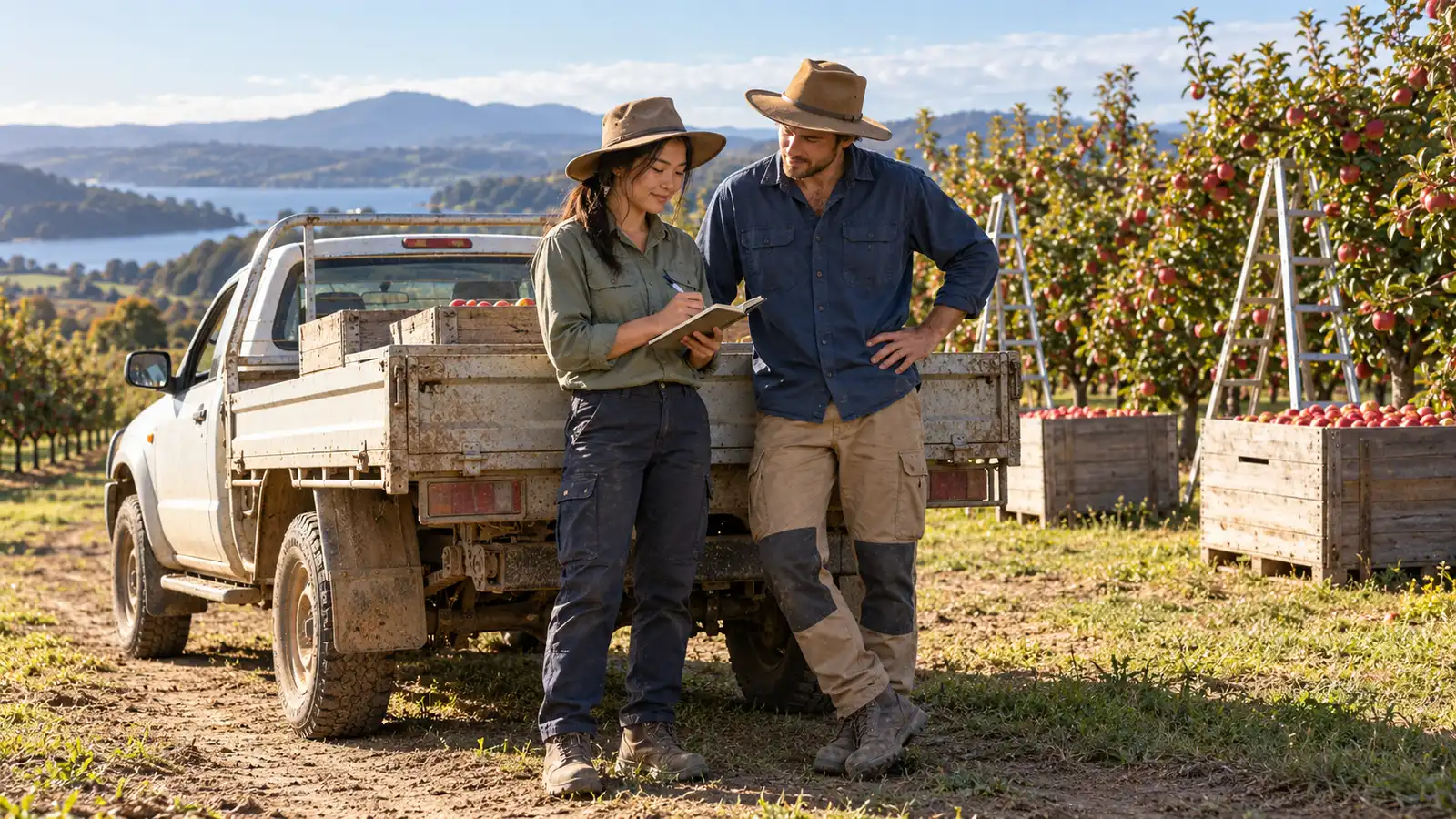
Winter farm work in Australia, roughly June to August, leans towards pruning, root vegetables, citrus and shearing sheds rather than summer fruit picking. The official harvest calendars from Tasmania, South Australia and Western Australia show real winter work, but it sits in particular regions, so the best plan is to pick a region first and a crop second.
This guide lays out what is typically on offer in the colder months, which of it can count towards the 88 days for a second Working Holiday visa, and how to avoid arriving in the wrong place at the wrong time. For the whole year at a glance, keep the Seasonal Jobs Australia harvest calendar open alongside it.
Winter farm work at a glance
These windows come from state government pages, not from job ads, so treat them as typical seasons rather than a promise that work is open this week. Dates move with the weather, the crop and each grower.
| Type of work | Where | Typical timing |
|---|---|---|
| Wine grape pruning | All three Tasmanian regions | June to August |
| Carrots | Tasmania's north and north-west | January to August |
| Processing potatoes | Tasmania's north and north-west | February to August |
| Hop stringing and training | Tasmania's north-west and south | June to November |
| Shearing shed hand work | Tasmania's north-west and south | April to August |
| Citrus, including Riverland navel oranges | South Australia | Generally peaks in the colder months |
| Vegetables | Carnarvon district, Western Australia | Main season in autumn, winter and spring |
The Tasmanian Department of Natural Resources and Environment says the state has harvest jobs for nearly 12 months of the year. Its seasonal produce harvest dates page is the one to check before you book anything.
Pruning: the classic winter job
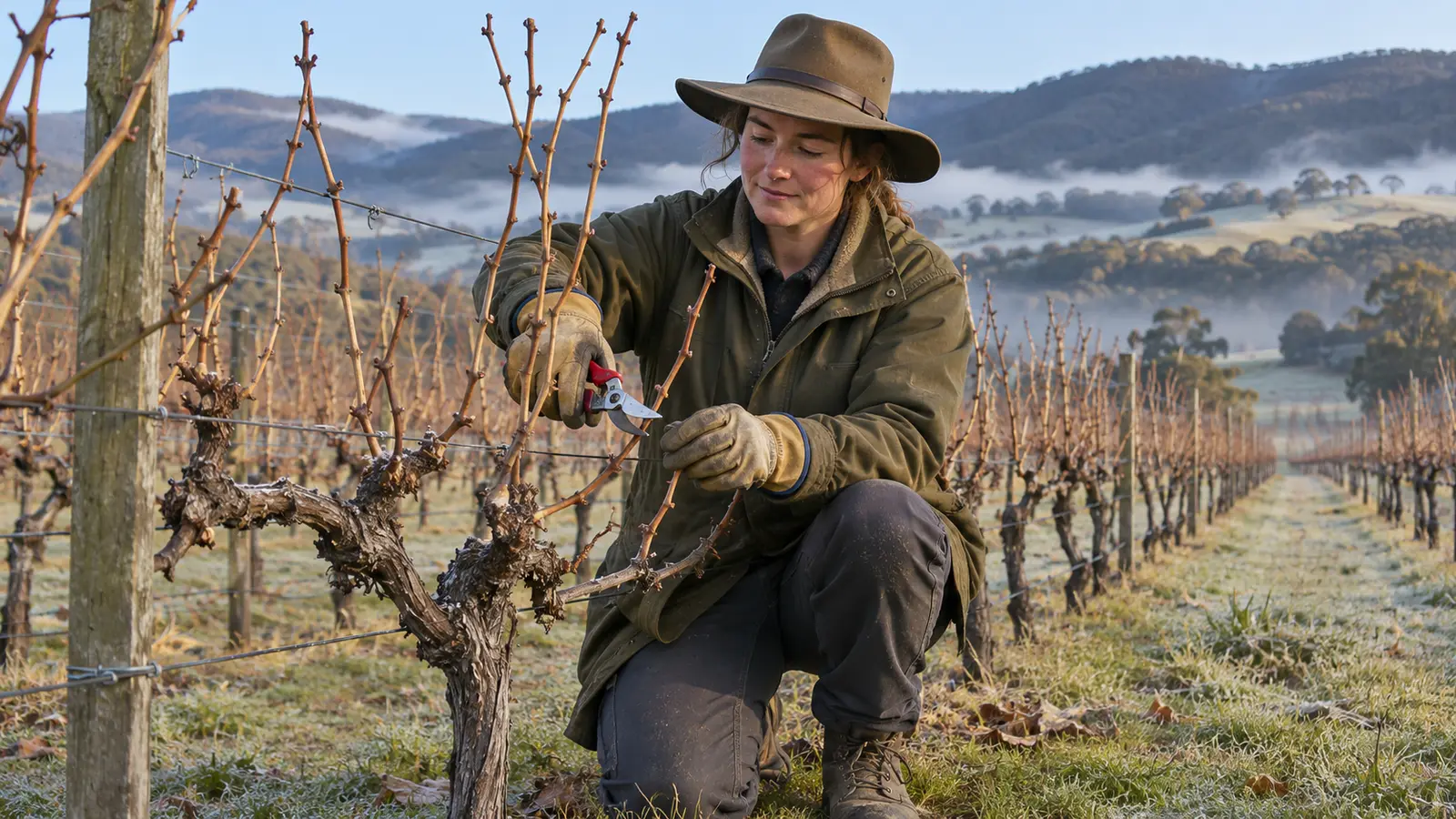
When the vines are bare, the work is pruning and tying down rather than picking. In Tasmania, wine grape pruning runs from June to August in every region. The Horticulture Award names pruning grape vines as a piecework task, so you may be offered a piece rate rather than an hourly wage.
If you are new to it, ask how much training is given. Pruning is skilled work, and a slow first fortnight is normal. A good supervisor shows you the cuts on a few vines and checks your first rows. A worker who is shown nothing and expected to hit a target from day one is a warning sign; our payday check for farm and harvest work shows how to spot the problem on your first payslip.
Citrus, vegetables and sheds
South Australia's government says citrus there generally peaks in the colder months, with Riverland navel oranges among the premium produce (media release of 29 May 2026). That points to citrus picking and packing as a winter option for anyone willing to work in the Riverland. Our South Australia work guide covers the state's regions and rules.
In Western Australia, the Carnarvon district's major vegetable season runs through autumn, winter and spring, supplying Perth and interstate markets with counter-season produce. The district has over 1,500 hectares of horticulture, so it can be a real option if you are happy to base yourself in the Gascoyne. Check the postcode before you go, because only listed Western Australian postcodes count as regional.
Not all winter work is outdoors in a row of plants. Packing sheds, shearing sheds and processing lines are other places to look. Our guide to seasonal jobs beyond fruit picking explains which of these count as specified work and which do not.
Does winter work count for your 88 days?
For a second Working Holiday visa you need at least 3 months of specified work, which Home Affairs takes as a minimum of 88 calendar days. The work has to be in an approved industry in an eligible area. Plant and animal cultivation can include pruning and trimming vines and trees for commercial horticulture, but only when that is the main task. General garden maintenance is not eligible.
| Question to ask | What Home Affairs says |
|---|---|
| Is pruning accepted? | It can be, when it is the main task and the work is commercial horticulture. |
| Is the winemaking side accepted? | No. Secondary processing such as winemaking, brewing and milling does not count. |
| Does the location qualify? | All postcodes in South Australia and Tasmania are regional for specified work; Western Australia is regional only for listed postcodes, including 6200 to 6799. |
| Do wet days count? | Unpaid days lost to severe or seasonal weather do not count, and there is no exception. |
That last row matters in winter. A week of rain with no paid work does not add to your total, and Home Affairs advises not leaving specified work until the end of your stay, to allow for bad weather, illness or not finding enough work. Read the official specified work conditions for the full rules, then see how the count works in practice in how to count 88 days when rain and short weeks get in the way.
Two more rules help with planning. Work on one calendar day cannot count as more than one day of specified work, so a ten-hour day is still one day. And specified work does not have to be done all in one go or with one employer, so you can stitch together several short winter jobs, as long as the total is not completed in a period shorter than 3 months. The 88 days guide sets out the whole picture, and the records to keep from day one will save you trouble when you apply.
What winter work pays
From 1 July 2026, the Horticulture Award minimum for an adult level 1 employee picking, sorting or packing fruit and vegetables is $25.74 an hour for full-time and part-time employees and $32.18 for casuals. For wine grapes the Wine Award applies: an adult grade 1 employee picking wine grapes or pruning wine grape vines gets at least $25.79 full-time and $32.24 casual.
Pay for pruning needs one extra check. The Wine Award has no minimum wage guarantee for pieceworkers. Under the Horticulture Award, a piece rate must let a pieceworker at the average productivity of a competent pieceworker earn at least 15% more than their hourly rate, and a competent pieceworker is one with at least 76 hours' experience of the task. Ask which award covers the job and ask for the rate in writing. Our piecework pay guide goes through the numbers, and the Fair Work Ombudsman has a page on pay and piece rates.
Under the Horticulture Award, an employer must give a pieceworker a written piecework record before piecework starts. It states the start date and time, the task, the piece rate, the hourly rate and the minimum wage guarantee statement. Keep your copy.
How to plan a winter of farm work
- Decide what you need the work for. If you are chasing 88 days, only specified work in an eligible postcode counts, so start with the postcode list and the industry rules.
- Pick one or two regions from the table above. A region with several winter crops, such as northern Tasmania, gives you a fallback if one job ends.
- Check the state government harvest page for that region, then search for current listings on the Seasonal Jobs Australia jobs page.
- Ask the employer which award applies, whether the pay is hourly or piecework, how many days a week the work runs and what happens on wet days.
- Sort out transport and a bed yourself before you commit. You have the right to choose where you live, even when an employer offers accommodation, and you should be wary of paying for accommodation before you have found a job.
- Keep every payslip and your own diary of days worked from day one.
If you are planning a longer route that links regions, our post on chaining fruit picking seasons into a working year show how people connect one job to the next. A tidy one-page application also helps; a tool such as Build AI CV can help you put your availability and visa dates at the top.
Common mistakes
- Arriving in the wrong region. Winter work is patchy, and the same month can be busy in one state and quiet in another.
- Counting on weather-affected days. Unpaid weather days do not count towards your 88 days, so a short winter job can take longer to add up than you expect.
- Assuming pruning always counts. It counts only when it is the main task in commercial horticulture, in an eligible postcode.
- Taking a piece rate without a written record. Ask for the piecework record before you start.
- Paying upfront. Be wary of anyone asking for money for accommodation before you have found a job.
- Leaving it late. Home Affairs advises not leaving specified work until the end of your stay.
Frequently asked questions
Is there farm work in Australia in winter?
Yes, but it is regional. Tasmanian government pages list wine grape pruning, carrots, potatoes, hop stringing and shearing shed work in the colder months, South Australia's citrus peaks in the colder months, and Carnarvon's vegetable season includes winter.
Which months count as winter for farm work?
In Australia, winter is June to August. Some crops overlap that window, such as Tasmanian carrots from January to August and potatoes from February to August, so a winter job can be the tail end of a longer season.
Does pruning count towards the 88 days?
It can. Home Affairs says plant and animal cultivation can include pruning and trimming vines and trees for commercial horticulture when that is the main task, as long as the work is in an eligible area and paid under Australian law.
Do days lost to rain count?
No. Unpaid days when you did not work because of severe or seasonal weather do not count, and Home Affairs makes no exception for missing the minimum period because of weather or any other reason.
How much should I be paid for winter farm work?
From 1 July 2026 the Horticulture Award minimum for a level 1 adult is $25.74 an hour, or $32.18 for a casual. Wine grape pruning falls under the Wine Award, at $25.79 full-time and $32.24 casual for a grade 1 adult.
Which visa do I need to do specified work for a second visa?
Check your visa conditions on the Home Affairs website first. Specified work for a second visa must, as a rule, be done while you hold the first Working Holiday visa, and all of it must be paid in line with Australian legislation and awards.
Rules, pay rates and visa conditions can change. Check the official government website before you act.
Key takeaways
- Winter farm work is regional: think Tasmanian pruning, carrots and potatoes, South Australian citrus and Carnarvon vegetables.
- Pruning can count towards the 88 days when it is the main task in commercial horticulture in an eligible postcode.
- Unpaid weather days do not count, so start your specified work early.
- Ask which award applies and get any piece rate in a written piecework record before you start.
- Keep payslips and a diary of days worked from day one.