Farm safety for seasonal workers starts with the hazards that hurt people most often: vehicles and quad bikes, heat and sun, heavy or repetitive lifting, chemicals, animals, fatigue and working alone far from help. Safe Work Australia calls agriculture one of the most dangerous industries to work in. The farm business has to manage those risks, you have to follow its safety instructions, and as a visa holder you have the same workplace protections as everyone else.
The hazards you will meet on an Australian farm
Safe Work Australia's agriculture safety page lists tractors, motorbikes and quad bikes, pesticides and other chemicals, noise, dust, sun and weather, and working with animals, often alone or in remote areas. The right-hand column below is what to ask about at your induction.
| Hazard | Where seasonal workers meet it | What to ask or check |
|---|---|---|
| Vehicles, tractors and quad bikes | Orchard rows, bin trailers, farm tracks, shed loading areas | Who may drive what, where pickers walk, helmet rules |
| Heat and sun | Open rows, vineyards, hot sheds in summer | Water, shade, start times, the plan for very hot days |
| Lifting and repetitive work | Bending for strawberries, ladders and picking bags, cartons on a packing line | Lifting aids, task rotation, breaks |
| Chemicals, dust and noise | Sprayed blocks, chemical stores, dusty sheds, machinery | Which blocks were sprayed, protective gear, where to wash |
| Animals | Shearing sheds, yards, cattle and sheep work | Who handles stock, how to move around animals |
| Fatigue and isolation | Long shifts, early starts, remote blocks with weak phone coverage | Check-in system, emergency plan, first aid location |
Vehicles, tractors and quad bikes: the biggest risk
Safe Work Australia says tractors, aircraft, quad bikes and other vehicles cause over 75% of workplace deaths in agriculture. For a picker that means tractors pulling bin trailers along the rows, utes on dirt tracks and forklifts around the shed. Make eye contact with a driver before you walk near a moving tractor, keep off trailers and bins, and never drive anything you have not been trained and authorised to use.
If you are asked to ride a quad bike, Safe Work Australia's quad bike safety advice is to ride on flat, stable terrain, never carry passengers on single-operator bikes, avoid towing and loads where possible, use active riding techniques and always wear a helmet that fits well. Almost 1 in 6 fatal quad bike incidents involve people under 16, who should never ride adult-sized quad bikes.
Station and shed work bring their own vehicle and stock risks: our guide to seasonal jobs beyond fruit picking explains what that work involves day to day.
Heat, sun and dehydration
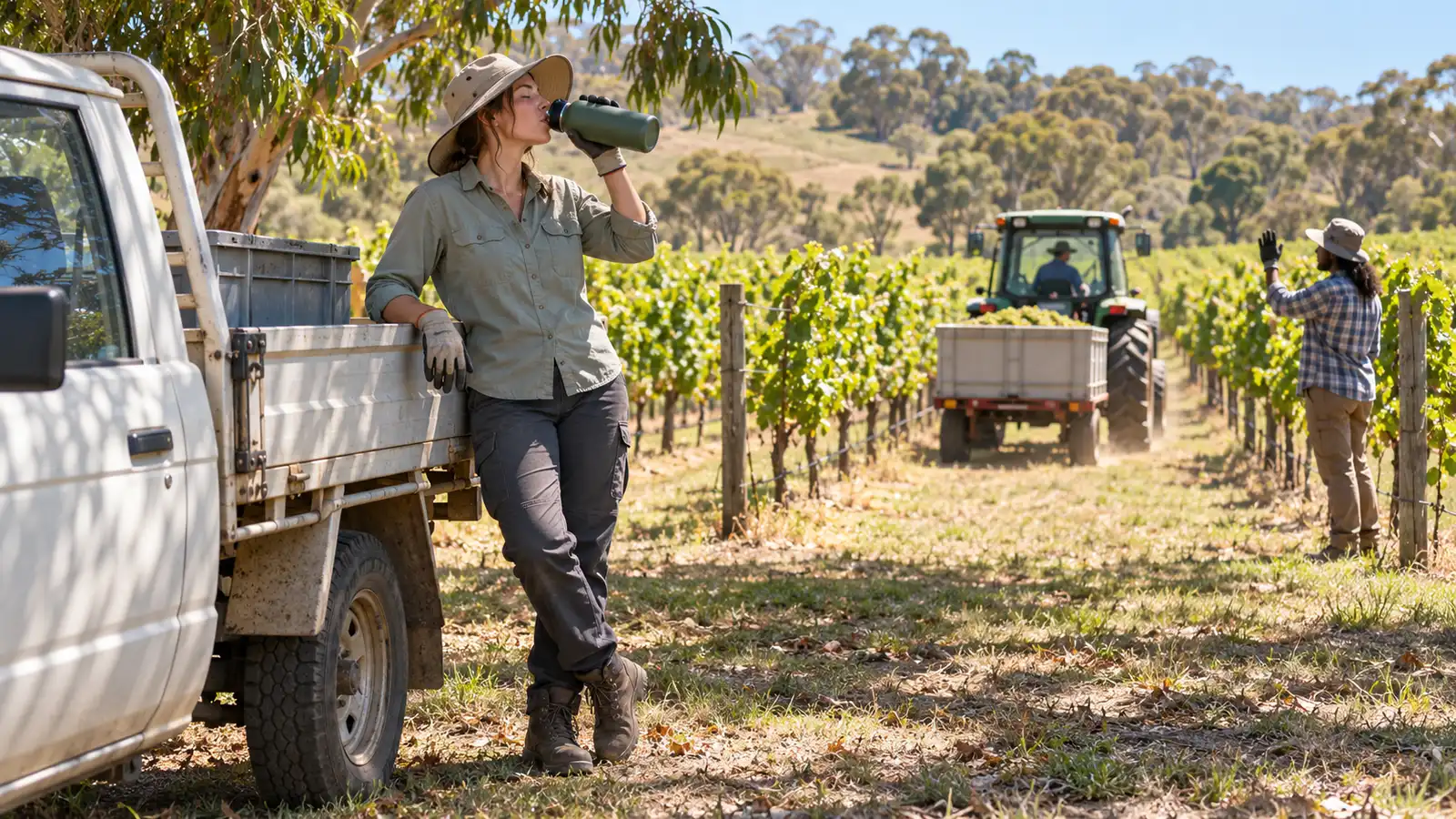
There is no single maximum temperature at which work must stop. The business must eliminate or minimise heat risks so far as is reasonably practicable, which may mean cancelling or rescheduling tasks until it is cooler. In a heatwave, controls include working in the cooler parts of the day, less physical effort, and cool fresh water and shade.
Young workers (under 25), older workers, pregnant women, people with an illness such as heart disease and anyone not yet used to the heat are most at risk. Many new arrivals fit at least one of those.
Watch for dizziness, sweating, visual disturbances, fainting, nausea and muscle cramps: heat illness gets worse if untreated and can be life threatening. If someone stops sweating, becomes disoriented, breathes fast, vomits or will not drink, it may be heat stroke, so call Triple Zero for an ambulance straight away.
Sun is a year-round hazard. Solar ultraviolet radiation is the leading cause of skin cancer in Australia, so the business must manage it with shade, scheduling, sun protective clothing, hats, sunglasses and sunscreen. For a shift-by-shift plan, read our heat-ready harvest work plan.
Lifting, bending and repetitive work
Repetitive lifting, carrying, awkward postures and sudden force cause sprains, strains and back injuries, the kind that quietly end a season early.
The crop decides the strain: strawberries keep you bent low, trees mean ladders and a heavy picking bag, sheds mean standing and lifting cartons. Our guide to fruit picking jobs by crop type helps you choose work your body can manage.
The Horticulture Award allows a meal break of not less than 30 minutes and not more than one hour, taken no later than 5 hours after starting, and a paid rest break of 10 minutes each day or shift. Use them to stretch, drink and get out of the sun, and ask for lifting aids and task rotation.
Chemicals, sap and animals
Ask at your induction which blocks have been sprayed and when you may enter them, what protective gear the task needs, and where to wash your hands before you eat. The Northern Territory Government warns that mango sap is caustic and can irritate the skin, so cover your arms in mango season.
For growers, the induction is one step in a longer list: see our checklist for hiring seasonal workers in Australia, from work rights checks to final pay.
In shearing sheds, yards and paddocks, stay out of the way until someone shows you how the stock move, and keep clear of working dogs you do not know.
Fatigue and working alone
Long days, pre-dawn starts and remote blocks with weak phone coverage make every other hazard worse. A farm business must prepare and maintain an emergency plan and make sure workers can reach first aid equipment and trained first aid officers whenever they work. Ask how the farm keeps track of people working away from the crew, tell your hostel where you are, and do not drive country roads half asleep.
A first-day safety routine for any new farm
Our 10 questions for your first farm job cover the employment side. For safety, do this on day one:
- Go to the induction and ask about anything unclear. Training and meetings are work, and your employer must pay for all work you do.
- Find the first aid kit, the first aid officers and the emergency meeting point.
- Ask which vehicles move where and where pickers should walk.
- Ask where the water and shade are, and what happens on very hot days.
- Check the gear the task needs (hat, sun shirt, gloves, boots, eye protection) and who supplies it.
- Save the number of the person you report hazards and injuries to.
- Start a daily note of hours and tasks; Fair Work's Record My Hours app records hours, place and type of work.
If training time is missing from your payslip, our 10-minute payday check shows how to compare it with the award. The first week in seasonal work guide covers the rest of your settling-in checks.
Your rights when work feels unsafe
Visa holders and migrant workers have the same workplace rights and protections as all other employees in Australia. In return, workers must take reasonable care of their own and others' health and safety and follow reasonable safety instructions.
If a task looks unsafe, stop and tell your supervisor. Where there is a trained Health and Safety Representative, they can direct workers to stop unsafe work if they reasonably believe an immediate or imminent hazard poses a serious risk, usually after first trying to resolve it with the business. See Safe Work Australia's page on what to do if work becomes unsafe.
An employer can't fire you, cut your shifts or punish you because you complained or asked questions about your work. An employer also can't cancel your visa: only Home Affairs can. For help in another language, call the Translating and Interpreting Service on 131 450 and ask for the Fair Work Ombudsman on 13 13 94.
For the pay and award rules behind any job offer, Talynx has a guide to workplace rights in Australia.
Latest update for labour hire workers in Victoria
In Victoria, if a contractor employs you to pick, pack or plant fruit or vegetables, you are probably a labour hire worker and your employer must hold a licence. From 1 October 2026, Victoria's definition of labour hire covers labour supply anywhere in a supply chain. Victorian labour hire workers can report safety risks, unfair pay or unsafe employer-provided accommodation to the Labour Hire Authority on 1300 545 200. Our labour hire guide shows how to check a provider, and the accommodation and transport guide covers your right to choose where you live.
If you get hurt or sick at work
Get first aid, and call Triple Zero for anything serious. Report the injury to your supervisor the same day and write down what happened, when and who saw it.
Home Affairs counts sick days, or equivalent workers compensation leave days, as specified work only if you are paid for them. Our post on the records to keep from day one shows a simple daily note that makes those days easy to prove.
If you hold a first aid certificate or a forklift licence, list it near the top of your CV. Build AI CV can help you set out your skills and tickets for farm and packing-shed applications on your phone.
Common mistakes seasonal workers make with safety
- Riding on trailers, bins or the back of a ute because everyone else does.
- Jumping on a quad bike without training or a helmet.
- Treating heat illness as tiredness and pushing on to finish the row.
- Skipping breaks to pick more on a piece rate.
- Hiding an injury for fear of losing shifts or specified work days.
- Working alone in a remote block without telling anyone where you are.
Rules, pay rates and visa conditions can change. Check the official government website before you act.
Frequently asked questions
Who is responsible for safety on an Australian farm?
The farm business has to manage the risks, prepare an emergency plan and make sure you can reach first aid equipment and trained first aid officers whenever you work. You also have a duty: take reasonable care of your own health and safety and that of others, and follow reasonable safety instructions.
Is there a temperature at which farm work must stop?
No. Safe Work Australia says there is no single maximum temperature at which work must stop. The business must remove or reduce heat risks as far as is reasonably practicable, which may mean cancelling or moving tasks until it is cooler.
Can I lose my job for reporting a safety problem?
An employer cannot fire you, cut your shifts or punish you in other ways because you complained or asked questions about your work. An employer also cannot cancel your visa: only Home Affairs grants, refuses or cancels visas.
Should a working holiday maker ride a quad bike on a farm?
Only if the farm has trained and authorised you, and always with a helmet that fits well. Safe Work Australia advises flat, stable ground, no passengers on single-operator bikes and avoiding towing and loads where possible.
Do days off after a farm injury count towards my 88 days?
Home Affairs counts sick days, or equivalent workers compensation leave days, as specified work only if you are paid for them. Keep your own record of the dates and check the Home Affairs rules for your visa before you rely on those days.
Key takeaways
- Vehicles, tractors and quad bikes cause over 75% of workplace deaths in agriculture: stay visible and never drive without training.
- There is no single stop-work temperature, so know the signs of heat illness and call Triple Zero for suspected heat stroke.
- Use your meal and rest breaks, and ask for lifting aids and task rotation.
- Visa holders have the same workplace protections as everyone else, and complaining about safety must not cost you shifts.
- Keep a daily record of hours and any injury: paid sick days can count as specified work, unpaid ones cannot.